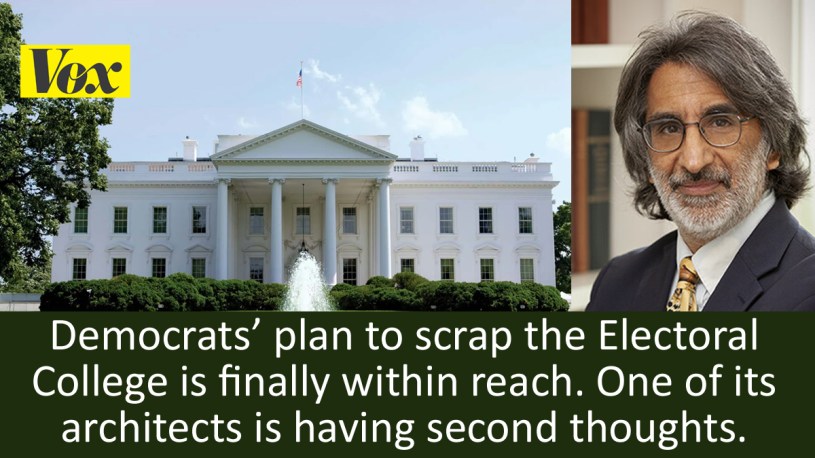
In 2001, Akhil Amar proposed a plan to bypass the US Electoral College. Now that it might happen, he worries it could go badly wrong.
[Excerpts of article published under the heading “Democrats’ plan to scrap the Electoral College is within reach. One of its architects has second thoughts” on Vox website on 12 November 2026]
[By Andrew Prokop]
The 2026 blue wave could end up washing away the Electoral College. In addition to winning Congress, Democrats won full control of state governments in Arizona, Michigan, Nevada, Pennsylvania, and Wisconsin. That means that a two-decades-in-the-making plan to switch our presidential elections to a popular vote system — a plan 18 states have already approved— could cross the threshold that would make it a reality.
The plan is the National Popular Vote Interstate Compact (NPVIC). A state signing on to the compact agrees that, rather than awarding its electors to the presidential candidate who won statewide, it will allot electors would to the presidential candidate who won the national popular vote. The catch is that each state will only do so if enough other states have signed on to determine the outcome. …
So it could actually happen — the Electoral College could be effectively abolished before 2028.
And that’s making Yale University law professor Akhil Reed Amar nervous.
One might think he’d be thrilled about this, because, back in 2001, Amar co-wrote an article advancing something close to what became the National Popular Vote Interstate Compact. Earlier this year, he told me he considered the idea “my baby — maybe not mine uniquely, but my baby.”
But then he used some different analogies: “This is like Doctor Strangelove. I created this doomsday machine, like Edward Teller. Well done, Amar — you just destroyed the universe!” That’s because Amar has come to believe the compact has some very serious flaws — flaws that could set the stage for a nationwide electoral disaster.
So, now that Democrats have gained enough governorships and state legislative majorities to make it a reality if they so choose, I wanted to talk again with Amar — who’s also spoken about this on his podcast — to understand his misgivings.
Why has Amar turned against the idea? What are the flaws that concern him — and are they fatal ones? Our conversation, which has been condensed and edited, follows.
How Akhil Amar started off as an Electoral College critic
You’ve been thinking about this idea of Electoral College reform, and in particular this unusual route of reforming the Electoral College without a constitutional amendment, for a long time. Walk me through how it started for you.
The week before the 2000 election, I taught a class at Yale. Cable news came to my class and heard me predict that there was a great possibility that there might be an inversion between the Electoral College vote and the popular vote. And I said, the inversion could favor either party.
There was indeed an inversion. The New York Times called me, I think, on Wednesday and asked if I had some thoughts. I said, oh, I do. I highlighted the pro-slavery origins of the Electoral College. Because of the three-fifths clause, states with lots of slaves got the benefit of their slave population, with a discount, in the electoral vote. In a direct popular election system, they couldn’t have counted their slaves.
I wanted Americans to know that because the South voted mainly for Bush in 2000, it once again benefited from the Electoral College. So that’s what I felt right after the election.
A year passes. And on the one year anniversary of Bush v. Gore, I publish a trilogy of internet posts with my brother, Vik. In part three we floated, just as a thought experiment, a way of improvising a direct national election that wouldn’t require a constitutional amendment. …
Akhil Amar’s critiques of the National Popular Vote Interstate Compact
So let’s get into what you call the glitches. What is different about and in your view wrong with the version of the compact that states have passed, as compared to your preferred version?
Here’s one thing that I could not have anticipated in 2001: that only blue states would hop on the bandwagon.
My thought was, the Electoral College in 2000 happened to favor Bush, but it could have favored Gore, and the next time it might favor the Democrats. So this, I thought, would not be perceived as some Democratic partisan scheme.
“If the whole idea is that the national popular vote is fairly counted, it’s hard unless there’s buy-in by the counters everywhere, including in red states.”
But in the years since then, in part accelerated by a second inversion between Hillary Clinton and Donald Trump, the perception emerged, perhaps incorrectly, that the Electoral College was skewed in favor of Republicans. And if so, why should they change that?
So as more and more states have jumped on the NPVIC bandwagon, they’ve almost all been sapphire blue or blue-tinged states, with no ruby red states on board. That portends poorly to the success of the plan, because even if you got to 270, if you do that only with blue state buy-in, there could be ways in which red states might try to sabotage the system.
As an example: We have an election. It’s nationally very close in the popular vote. So we want to do a proper recount to make sure that the result goes to the popular vote winner. But some ruby red states will say, “We weren’t part of this plan ever. The election in our state wasn’t particularly close. We don’t want to pay for any recount.”
If the whole idea is that the national popular vote is fairly counted, it’s hard unless there’s buy-in by the counters everywhere, including in red states.
That gets at what you characterize as another big glitch, which is: Under this plan, there is no centralized body to determine what the national popular vote tally is. It’s just left up to each state, to add up the vote totals from all the other states. You see this as a big problem.
My 2001 thought experiment detoured around all that by envisioning an NGO to administer this thing. You could also have a congressional statute coming up with rules for administering a national count and recount.
But here’s a problem: A national apparatus for counting or recounting would be controlled by a president. Maybe an incumbent president running for reelection. Would that incumbent president actually act properly and fairly? Let’s imagine that incumbent president is named Donald Trump, and it’s 2020.
People say, “States do it all the time, they handle counting and recounting, why can’t the federal government?” Most state governments don’t control millions of stormtroopers, a massive army of ICE agents and the like.
But the current proposal that states are adopting doesn’t have any national body at all to oversee the vote tally, and you think that’s a serious problem too.
Yes, it’s Scylla and Charybdis. Here are the problems on the other side.
Let’s say, California says, “Gee, let’s let 17-year-olds vote because there’ll be more Californians in the national popular vote that way.” Then Florida says, “We’re going to let 16-year-olds vote.” And then Arkansas says, “We’re going to let dogs vote. Or we’re going to let parents vote for 12-year-old children.”
Some states make it really easy to vote and register to vote, some states don’t. Is it really a national popular vote — a “one person, one vote” system — if you have huge variation in voter eligibility, voter registration, administration on Election Day, or election month as it is in some places.
Or, states agree to this plan. They add up to 270. And then as Election Day approaches, something may happen in an individual state, and they try to back out. What’s going to happen in that situation? Or what if they don’t back out in advance of the election, but try to change their rules after election day? What happens if a state supreme court says, “That’s not consistent with our state constitution?”
What I don’t want is for a deeply imperfect, historically tainted Electoral College system — that for all its flaws, actually works — to be replaced by a possibly catastrophic, legally glitchy new system where we don’t know who’s president, where we don’t know who won the popular vote.
The one thing we really do need to avoid as the stabilizing superpower in the world is constitutional chaos. And because this is sort of a new plan, even if it’s in principle likely to be better in all sorts of scenarios, if in a certain small percentage of cases it would lead to chaos, that’s something we need seriously consider. …
[Andrew Prokop is a senior politics correspondent at Vox.]
Also Read…
Should the Electoral College Be Abolished?

