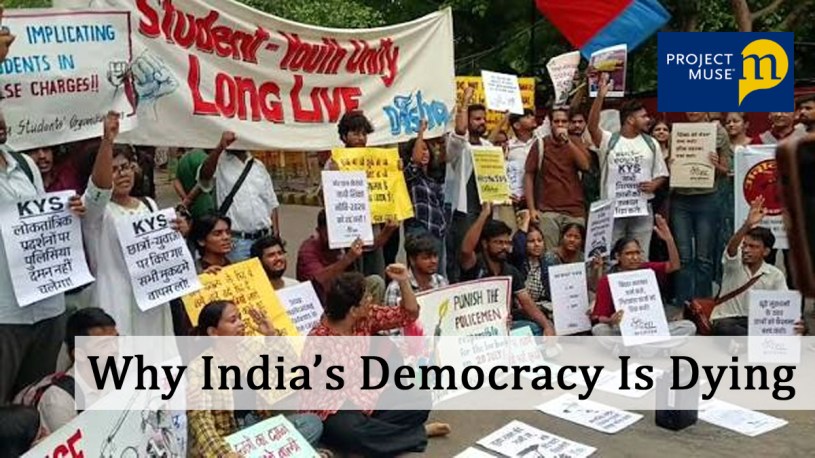
Democracy in India is not dying through a military coup or the mass arrests of opponents. Instead, autocrats have learned to talk democratically and walk autocratically, writes Maya Tudor, Professor of Politics at the University of Oxford.
[Excerpts of article published in the Journal of Democracy (July 2023) under the heading “Why India’s Democracy Is Dying” on the Project MUSE website]
[By Maya Tudor]
No country is a better exemplar of our global democratic recession than India. Most unlikely at its founding, India’s democracy confounded legions of naysayers by growing more stable over its first seven decades. India’s democratic deepening happened in formal ways, through the consolidation of civilian rule over the military as well as decades of vibrant multiparty competition, and informal ways, through the strengthening of norms around Electoral Commission independence and the increasing participation of women and other social groups in formal political life.
India has also witnessed two significant democratic declines: the 21-month period from June 1975 to March 1977 known as the Emergency and a contemporary decline beginning with Narendra Modi’s election in 2014. During Modi’s tenure, key democratic institutions have remained formally in place while the norms and practices underpinning democracy have substantially deteriorated. This informal democratic decline in contemporary India stands in stark contrast to the Emergency, when Indira Gandhi formally eliminated nearly all democratic institutions—banning elections, arresting political opposition, eviscerating civil liberties, muzzling independent media, and passing three constitutional amendments that undermined the power of the country’s courts.
Yet democracy watchdogs agree that today India resides somewhere in a nether region between full democracy and full autocracy. While democracy-watching organizations categorize democracies differently, they all classify India today as a “hybrid regime”—that is, neither a full democracy nor a full autocracy. And this is new. In 2021, Freedom House dropped India’s rating from Free to Partly Free (the only remaining category is Not Free). That same year, the Varieties of Democracy (V-Dem) project relegated India to the status of “electoral autocracy” on its scale of closed autocracy, electoral autocracy, electoral democracy, or liberal democracy. And the Economist Intelligence Unit moved India into the “flawed democracy” category on its scale of full democracy, flawed democracy, hybrid regime, and authoritarian regime. India’s democratic downgrading moved 1.4 billion of the world’s 8 billion people into the category of autocratizing countries. Its drop from Free to Partly Free fully halved the share of the world living in a Free country.
…
Some disagree that India has substantively deteriorated into hybrid-regime territory. Unsurprisingly, the Indian government has reacted with accusations of Western bias, calling India’s democratic downgrade “misleading, incorrect and misplaced.” In August 2022, the Economic Advisory Council to India’s prime minister released a working paper calling out inconsistencies in democracy rankings. Yet there is reason why regime assessments, like a central bank’s interest rates, are best made by independent organizations. Notably, democracy watchdogs have not been shy about critiquing the quality of Western democracies.
But a minority of independent voices also resist India’s recategorization as a hybrid regime. In the article “Why India’s Democracy Is Not Dying,” Akhilish Pillalamarri writes that “cultural and social trends [in India today] are not necessarily evidence of democratic backsliding, but are rather evidence of social norms in India that are illiberal toward speech, individual expression, and criticism.”
So has India really departed the shores of democracy? And if so, is India’s transition into a hybrid regime reversible? The answer to both questions is yes.
Eroding Democratic Institutions
Scholars mostly agree that five institutions are central to a country’s designation as democratic. Of these five institutions, elections for the chief executive and legislature are the first and most important. The second institutional pillar of democracy is thus the presence of genuine political competition. Countries where individuals have the right to vote in elections, but where incumbents make it difficult for the opposition to organize are not generally considered democracies. Democracy also requires governmental autonomy from other forces—such as a colonial ruler or powerful military elites—that can halt or wholly subvert democratic elections; this autonomy is the third institutional pillar.
Two more institutions are also conceptually crucial to democracy because they enable both citizens and independent branches of government to evaluate the government’s performance: civil liberties (both de jure and de facto), the fourth pillar, and executive checks, the fifth pillar. Many prominent scholars have correctly argued that definitions of democracy which do not include basic civil liberties are inadequate. An independent press that enables the formation of critical public opinion is increasingly understood as being part of this civil-liberties pillar. The final institutional pillar of democracy, executive checks, is what prevents an elected head of government from declaring l’état, c’est moi. Democracy is a set of institutions that embed a practice of government accountability. This accountability takes two forms: vertical accountability between the people and the highest levels of elected government, typically elections and alternative political forces; and horizontal accountability between the executive and independent institutions, typically independent legislatures and courts that can constrain an elected executive from trampling on civil liberties.
…In the past half-century, as authoritarian leaders have learned to adopt the window-dressing of democracy while quashing those institutions essential to its functioning, democracy watchdogs have wisely adapted by seeking to better assess whether government institutions embody accountability and whether institutional rights exist not just in law but in practice.
…the clearest signs of such democratic erosion are that elected leaders question the legitimacy of all opposition and use every available legal tool to undermine it. Drawing on a broad range of historical cases, Steven Levitsky and Daniel Ziblatt argue that unwritten rules and norms of behavior toward political opposition are the key to preventing such democratic deterioration. They argue that the two most important norms are opposition tolerance, meaning that political opponents are not treated as enemies but simply as political rivals, and forbearance, that is, limited use of the legal methods to steamroll opposition, such as executive orders, vetoes, and filibusters. Contemporary democratic backsliders tend not to transform overnight to autocracies. Instead, democracies slowly die when opposition is no longer tolerated and when elected politicians use the full might of the law to quash rather than compromise with political opposition.
Declining Liberties
India’s democracy was never very high-quality. The formal exercise of autonomous, competitive elections with a broad range of civil liberties—while it did translate into a mass poverty-alleviation program and the world’s largest affirmative-action program—always had plenty of shortcomings. But democracy also had a built-in autocorrect feature, which allowed incumbents to be turned out of power. That autocorrect feature is endangered today in mostly informal ways. In terms of Freedom House’s political-rights score (encompassing the pillars of elections, competition, and autonomy), India’s average for the nine years before Modi came to power was the same as for the nine years since 2014. Incumbent turnover remains electorally possible but improbable because the Modi government has substantially eroded the de facto protection of civil liberties and executive constraints—the fourth and fifth pillars of democracy. It is the drop in India’s civil-liberties rating that accounts for its contemporary democratic decline.
The legal right to dissent, historically only erratically protected in Indian courts, remains legally in place while the practical possibility of vocal dissent free from overwhelming harassment has virtually disappeared. To be sure, India’s media, while generally vibrant and free, were sometimes censored before Modi’s Bharatiya Janata Party (BJP) government came to power in 2014. But today, while the media remain legally free to dissent, widespread harassment of independent journalism and concentrating ownership structures have meant that journalists and individuals practice a high degree of self-censorship. Checks on executive power, while formally in place, are rapidly falling away.
Since 2016, civil liberties have been curtailed, to some extent legally and to a significant extent practically. CIVICUS, an international organization that tracks global civil liberties in 197 countries, now classifies India as “repressed” on its declining scale of open, narrowed, obstructed, repressed, and closed. …
The Modi government has increasingly employed two kinds of laws to silence its critics—colonial-era sedition laws and the Unlawful Activities Prevention Act (UAPA). Authorities have regularly booked individuals under sedition laws for dissent in the form of posters, social-media posts, slogans, personal communications, and in one case, posting celebratory messages for a Pakistani cricket win. Sedition cases rose by 28 percent between 2010 and 2021. Of the sedition cases filed against citizens for criticizing the government, 96 percent were filed after Modi came to power in 2014. One report estimates that over the course of just one year, ten-thousand tribal activists in a single district were charged with sedition for invoking their land rights….
The frequent invocation of these strengthened laws is substantively new and has significantly chilled dissent. The state has intimidated opposition by broadly labeling criticisms of government policy as contrary to the national interest, or “anti-national,” and by employing an army of volunteers to identify problematic online dissent. BJP politicians have popularized the term “anti-national” in patterns that target individuals, causes, and organizations. Academics were first to be targeted, with university administrators and faculty investigated, disciplined, or compelled to step down owing to their perceived political views. But such tactics were quickly broadened to include any high-profile dissenters. …
The government has frequently barred access to the internet, the de facto means of coordinating protest. India not only leads the world in government-directed internet shutdowns, with 84 government-directed shutdowns in 2022, but these blackouts are typically imposed before and during protests to impede effective public coordination, often without clear criteria for suspension. The report finds that while de jure protections for speech and assembly have eroded only marginally, de facto protections have significantly decreased.
Can Indian Democracy Be Saved?
Democracy in India, as elsewhere in the world, is not today dying through a military coup or the dramatic, coordinated mass arrests of opponents. Instead, autocrats have learned to talk democratically and walk autocratically, maintaining a legal façade of democracy while harassing opposition and shrinking space for loyal dissent. While India’s formal institutions of democracy are also under pressure—Modi’s most prominent political rivals have recently been disqualified from running in elections—it is primarily the inability of the ordinary citizen to read critical appraisals of government policy, to speak and assemble freely without fear of harassment as well as the absence of substantive checks on executive power that have transitioned India into a hybrid regime. …
Going forward, India’s surest route to democratic revival lies in the emergence of a genuine opposition party with well-developed organizational roots. The Indian National Congress was once such a party, but its grassroots linkages disappeared in 1969 when Indira Gandhi split the party and cut off grassroots-party infrastructure in her bid to centralize power. …
Maya Tudor
Maya Tudor is associate professor of politics and public policy at the Blavatnik School of Government at the University of Oxford.

