[By Bhanu Dhamija]
It is ironic that the task of explaining the differences between a King and a President fell to Alexander Hamilton. After all, Hamilton had originally proposed a presidency modeled on the British monarchy, complete with lifetime tenure and sweeping veto powers. When the Constitutional Convention in 1787 rejected Hamilton’s plan, he stormed out, returning only near the end of the proceedings, many weeks later. But he ultimately became one of the strongest defenders of the United States presidency as it was designed, writing most of the Federalist Papers in its support. In Federalist No. 69, he argued that comparisons between an American President and a king were misguided, emphasizing that the President would be elected, subject to regular elections, and vulnerable to impeachment.
Throughout American history, Presidents have often been accused of behaving like monarchs or exceeding their constitutional authority. George Washington was disparaged for his formal style and ceremonial presence; the Jeffersonian Republicans accused him of “wallowing, kinglike, in popular adulation.” Andrew Jackson was dubbed King Andrew the First for his aggressive use of the veto. Abraham Lincoln was called a dictator for suspending habeas corpus during the Civil War. Theodore Roosevelt’s expansion of executive powers earned him the nickname Theodore Rex, and his cousin Franklin was accused of harboring “kingly” ambitions when he proposed expanding the Supreme Court. Richard Nixon’s presidency gave rise to the term Imperial Presidency, and Barack Obama was condemned as a “perfidious king” for his frequent use of executive orders.
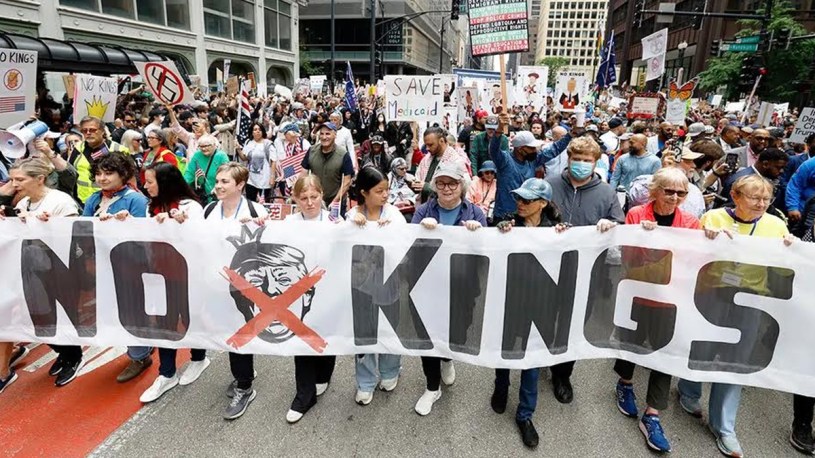
Last month, more than eight million Americans participated in No Kings Rallies protesting President Trump’s actions, which critics have described as authoritarian. Surveys reflect similar anxieties: a report last month by Bright Line Watch, based on responses from roughly 600 political scientists placed the United States midway between a Liberal Democracy and a Dictatorship. Likewise, Sweden’s V-Dem Institute recorded a sharp drop in the U.S.’s ranking of global democracies, from 20th to 51st out of 179 countries.
But developments on the ground suggest that fears of unchecked presidential power are overstated. Recent legal setbacks, combined with resistance from state and local governments, show that the Trump administration does not wield absolute authority. Electoral trends also point to potential constraints, as recent losses by the Republican Party raise the prospect of a more oppositional Congress, one that might investigate or pursue another Trump impeachment over alleged abuses of power.
Despite a conservative-leaning Supreme Court, this administration has encountered significant judicial resistance. Since January 2025, it has faced more than 350 lawsuits, resulting in more than 25 nationwide injunctions blocking major policies before they could take effect.
This judicial pushback has been especially pronounced in key policy areas. Federal courts have repeatedly halted major executive actions on issues like birthright citizenship, tariffs and detention of illegal immigrants. A federal judge in Boston blocked the administration’s attempt to end birthright citizenship, citing a violation of the 14th Amendment; the case is now before the Supreme Court. In February, the Court also struck down the administration’s tariff policy. Meanwhile, mandatory detention policies for undocumented immigrants have been challenged in hundreds of cases, with numerous rulings against the government.
Beyond the courts, efforts to restructure the federal bureaucracy have met strong resistance. Attempts to scale back agencies like USAID, eliminating most of its programs, have been tied up in ongoing legal disputes. In addition, a district judge ordered the reinstatement of thousands of dismissed federal employees, underscoring the limits on executive control over personnel decisions.
State and local governments are also playing a key role in checking federal power. More than 20 states have successfully challenged Trump’s attempt to freeze federal funding. In education, courts have struck down numerous efforts to restrict DEI (Diversity, Equity, and Inclusion) initiatives, ruling that such measures overstep federal authority.
At the same time, signs of weakening political support suggest that Trump will face further constraints ahead. In the past 14 months, Democrats have flipped 28 Republican-held seats in state legislatures, pointing to shifting electoral dynamics that could limit the administration’s agenda.
While concerns about executive overreach are valid, the evidence suggests that Donald Trump’s powers are far from unchecked. The system’s institutional safeguards—courts, states, and elections—continue to impose meaningful limits. So even though they might be strained, the constitutional guardrails of America’s democracy remain firmly in place.

