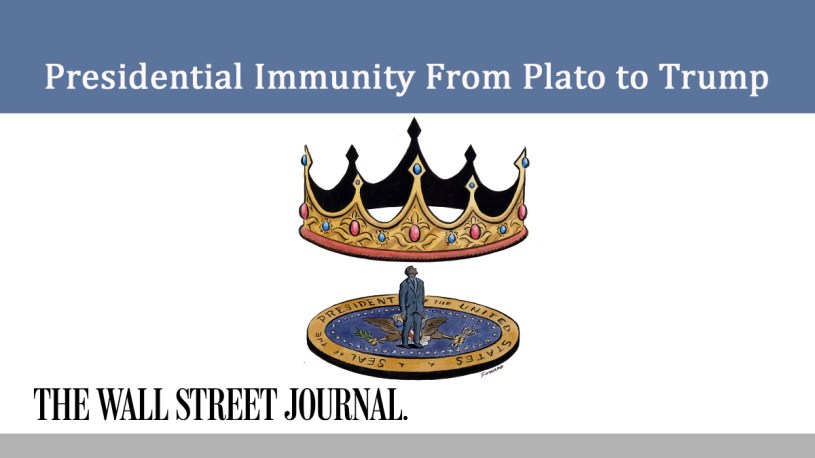
In the following article Harvey Mansfield, author of “Taming the Prince: The Ambivalence of Modern Executive Power,” discusses the U.S. Supreme Court’s recent ruling giving Presidents immunity for official acts.
[Excerpts of article published on the WSJ website on 06 September 2024.]
Presidential Immunity From Plato to Trump
The framers didn’t want a king, but a republic with a strong executive was an innovation in 1787.
[By Harvey C. Mansfield]
The Supreme Court case of Trump v. U.S. was about more than special counsel Jack Smith’s prosecution of Donald Trump, which continues under a superseding indictment handed up by a federal grand jury in Washington. The decision and the dissents contain a fundamental debate about the presidency that looks beyond the present personalities and campaign. Writing for the court, Chief Justice John Roberts concludes that the president has broad, though not unlimited, immunity from criminal prosecution. Outraged, the other side, led by Justice Sonia Sotomayor, declares that this makes him a king above the law and America not a republic (or a democracy).
The testy thrusts in the debate—“deeply wrong” from the minority and “tone of chilling doom” from the majority mocking the dissent—share the partisan heat of the case and the general bipartisan anger in our country. But this isn’t a new debate. In a separate lone dissent, Justice Ketanji Brown Jackson takes it back to Plato, where, let a professor tell you, it begins.
In claiming that the president’s immunity from prosecution makes him a king, Justice Sotomayor’s dissent (joined by Justice Jackson and Elena Kagan) recalls the republican cause before America changed it in the Constitution. That old cause, dating from the 17th century, said that a republic puts power in many hands—neither the few nor any one person but the people. To exercise its power a republic needs the rule of law as opposed to the rule of a king, and the rule of law is assured when the legislature, with its many hands, makes the law.
The executive office, though separate from the legislature, is subordinate to the latter because the former’s duty is to execute, or carry out, the law it doesn’t make. In this old view, it’s better that the executive be plural so that a single person isn’t tempted to become a king. A king is the main danger threatening every republic, and our republic, or democracy, will die should it elect an authoritarian like Mr. Trump who thinks he is king. Here I adapt President Biden’s critique of Trump v. U.S. to the minority opinion in the case.
Against this old-fashioned republican view, the majority rests on the innovation of the Constitution’s framers. It isn’t sufficiently appreciated that the U.S. is the first republic ever to be made with a single strong executive separate from the legislature and not dependent on it. Previously, the last thing a republic would want is a king. With our republic, however, the power of executing was “fortified” (in James Madison’s words) by giving to one person a share in legislation (the veto power), a power to pardon and the role of commander in chief of the military. In Article II the “executive power” is given as a whole with no specification of limited powers as for Congress, and the president takes his own special oath that he will “faithfully execute the office,” not merely the laws.
“Energy in the executive is a leading character in the definition of good government.” Executive energy must be protected, nourished and given opportunity.
A republic with a strong executive was a difficult sell in 1787 after the revolution against King George III, whose misdeeds were listed in the Declaration of Independence. But the need for a republican substitute near-king was argued in the Federalist Papers and sealed in its famous statement: “Energy in the executive is a leading character in the definition of good government.” Executive energy must be protected, nourished and given opportunity. And it has been.
…
How will the rule of law be affected by the president’s new immunity from it? Immunity will be granted for official acts, surely for core powers and probably for non core powers, and denied to unofficial acts that are private in nature. Here the majority opinion may encounter difficulties it doesn’t detail regarding the office of president. That office, to repeat and expand, is the greatest office in the country, and as of now in the world. From its executive aspect the president’s office not only covers the whole of American government and society, but also affects the rest of the world.
Two difficulties in executive power stand out for applying the provision of immunity—the need for secrecy and the ambivalence of responsibility. The need for secrecy in dealing with enemies and domestic opponents entails the need for lying. You can’t keep a secret without being ready to abandon your good faith. All governments need to lie, said our authority Plato, including the good ones. In lying to others, politicians lie with others they consort with in conspiracies, speaking to some in words they don’t use with others.
In some degree all governing is conspiracy, even for the Supreme Court, which jealously guards the confidentiality of its deliberations. The president and his family are protected by the Secret Service against assassins, who might need to be killed. The military executes “targeted killings,” resembling assassinations, against enemies abroad. These are events that Justice Sotomayor might want to exclude from her condemnation of immunity. The rule of law, after all, must be executed to be effectual, sometimes against vicious and ingenious resistance. The executive office at its highest has a terrific reach that is kept out of sight until it can be boasted of. At its peak it specializes in what is normally suspicious or downright illegal.
The reach of the executive brings up a second difficulty in its ambivalence. The word “executive” refers to a subordinate who carries out the order of a superior. This is enshrined by political science in the errand-boy theory of the presidency. If the president wants, he can excuse himself from an unpopular or disreputable deed by claiming that he acts only by order of a superior will of Congress, the people or even God. He can duck responsibility as a mere executive. Or he can expand the office he holds by claiming credit for something big and good, like the easing of inflation or the rise of the stock market or the sun. A nimble executive learns by experience of the ambivalence of his power, an invention of modern political science if anyone wants to know. Certain it is that the court, as the majority opinion says, needs to accommodate the limitation of the president’s power to the size it needs to be. …
[Mr. Mansfield is author, among other books, of “Taming the Prince: The Ambivalence of Modern Executive Power.”]
 Presidential System