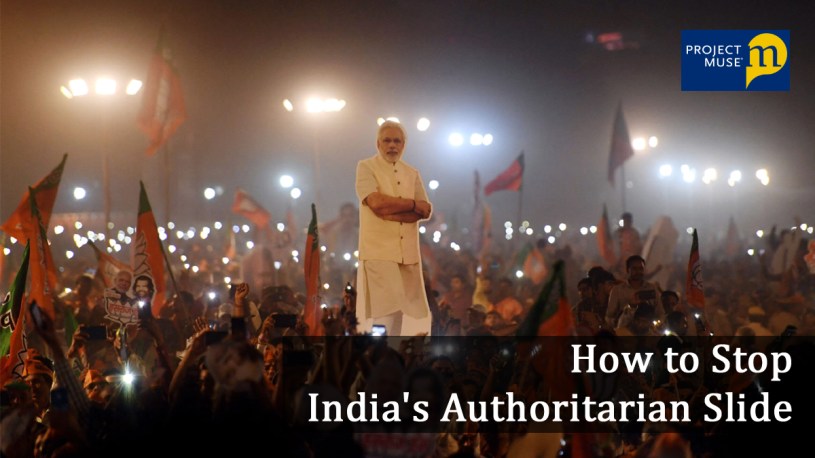
“If Congress and its allies unify and focus on bettering the lot of all Indians, and not just upper-caste Hindus, they just might halt the country’s authoritarian turn,” wrote Professor Rahul Mukherji in 2024.
[Excerpts of article published in the Journal of Democracy (January 2024) under the heading “How to Stop India’s Authoritarian Slide” on the Project MUSE website]
[By Rahul Mukherji]
Since Prime Minister Narendra Modi and the Hindu-nationalist Bharatiya Janata Party (BJP) came to power in 2014, the India’s democracy has flagged. Modi’s government has been squeezing civic space, attacking the press, political opponents, and nongovernmental organizations (NGOs), and stoking ethnic tensions. The state has also used an array of laws to harass critics of the regime. Yet there is still a chance that the power of the vote will lead to a democratic revival. A regime is most vulnerable at an intermediate level of repression: where the state is undermining the rule of law to an extent that is significantly harmful to the political opposition and civil society, but the electoral door to democratic revival has not yet closed completely. This is precisely where India is today. The most promising avenue of democratic resistance is at the subnational level. …
Modi’s government has been squeezing civic space, attacking the press, political opponents, and nongovernmental organizations (NGOs), and stoking ethnic tensions. Notably, the regime has been mobilizing Hindu voters, the country’s majority, by stirring their antipathy toward India’s significant Muslim minority. Civil society groups and political parties battling communalism are thus among the state’s biggest targets of repression, along with advocates for the rights of poor and marginalized people, as their interests diverge from those of the industrialists close to Modi.
The state has also used an array of laws, including the Prevention of Money Laundering Act (PMLA; 2002), the Foreign Contribution Regulation Act (FCRA; 2010), and the Unlawful Activities Prevention Act (1967), to harass critics of the regime, including rights defenders such as Teesta Setalvad and Harsh Mander, with arrests and raids, for example. Even the Supreme Court, the Election Commission, and Parliament have been compromised. …
Although the political playing field in India has undoubtedly become tilted against the opposition under Modi, there is still a chance that the power of the vote will lead to a democratic revival.
Democratic Resilience
The most promising avenue of democratic resistance in India today is at the subnational level. Almost half the country’s states and union territories are not governed by the BJP, and independent parties that currently support the ruling party can change their allegiance in response to changing political winds. Because there are more competitive races at the state level and because there is at present no national opposition party with sufficient resources and a strong enough organization to rival the BJP, Congress and the INDIA coalition should focus on winning state elections in preparation for the 2024 parliamentary elections.
In May 2023, Congress did just that, with a convincing victory in Karnataka—India’s sixth-largest state, and the only one in the south that the BJP controlled. In the run-up to the vote, the better-resourced BJP campaigned with Hindu-nationalist messaging and symbols, and Modi himself even traveled the state to campaign for the party. The BJP also used the state apparatus to go after opposition leaders, including the head of the Karnataka Congress party, D.K. Shivakumar, who is now the state’s deputy chief minister. Long in the BJP’s crosshairs, Shivakumar was first arrested in 2019 on tax evasion and corruption charges under the PMLA. Since November 2022, he has faced new but related probes by the Central Bureau of Investigation and the Enforcement Directorate of the Department of Revenue. …
Overcoming a Repressive Regime
How did Congress win in Karnataka in May 2023? The anti-incumbent factor was important. The state BJP government had drawn the citizens’ wrath for being excessively corrupt, economically regressive, and incredibly antagonistic toward the Muslim community, relentlessly promoting Hindu nationalism and encouraging anti-Muslim sentiment. …
Leadership, ideology, and voter orientation all came into play in this election. The BJP’s increasing repressiveness, along with its failure to address widespread economic distress, motivated the Congress party and civil society to join forces. These same adverse conditions together with strong leadership, helped the opposition both to dissuade potential spoilers from competing and to mobilize popular support for a progressive and secular ideal in a state with a significant Hindu majority.
Democratic Revival
There remain opportunities for the democratic opposition to prevail in India today. But they will be available only as long as the regime keeps its repression at the current level. If the political opposition misses this moment, India could veer into pure authoritarianism. If that happens, bringing the country’s democracy back to life will become an even harder task.
The democratic opposition at both the national and state levels should therefore closely study the lessons from Karnataka in 2023. First and foremost, the opposition must fight the authoritarian threat strategically. The INDIA coalition, however, has so far failed to formalize its structure and operations and act with discipline in its opposition to the BJP; perhaps coalition members do not yet believe that the threat from the ruling party merits the political costs such cooperation would entail. Second, opposition parties should invest in cultivating strong and appealing leaders who can connect with likeminded civil society groups and energize voters. And finally, the democratic opposition should offer a vision that serves the people. This strategy worked for Congress in Karnataka, where it successfully fought the BJP’s communalism and corruption with desperately needed welfare measures to help struggling families. Defeating Hindutva-based ethnonationalism is essential for protecting the constitutionally mandated plural character of India, which is what enabled the country to progress as a democracy from the time of its birth.
The national Congress party and INDIA coalition are already following this blueprint. They are, for example, proposing measures to help the country’s most disadvantaged groups such as a caste-based census to enable increased positive discrimination in school and job placements. This is a savvy strategy that could help to expose the hollowness of a Hindu nationalism that makes broad ethnic appeals but does little to improve Indians’ everyday lives. If Congress and its allies unify and focus on bettering the lot of all Indians, and not just upper-caste Hindus, they just might halt the country’s authoritarian turn.
[Rahul Mukherji is professor of Political Science in the South Asia Institute of Heidelberg University, Germany.]

