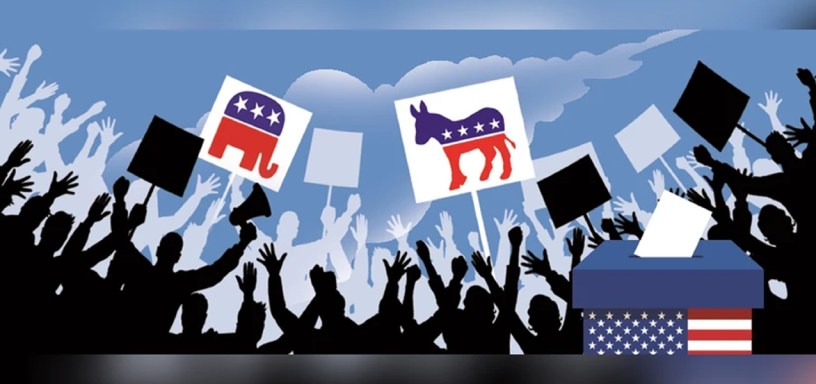
The greatest democracy on earth is now struggling because of its citizens’ stubborn embrace of partisanship, and their ignorance about their own government.
[By Bhanu Dhamija]
All democracies rely on the people’s wisdom for their survival. But the people’s ability to make good political judgement is not innate, and can never be taken for granted. Just ask Americans these days: only 38% today say they trust their fellow citizens when it comes to making political decisions. That number was 77% back in the 1960s.
Signs of declining political wisdom in the U.S. are everywhere. Most Americans say they feel exhausted or angry when they think about politics, and 80% describe today’s political climate using only negative words, like divisive, corrupt, and polarized. A staggering 84% believe political debate has become less respectful and less rooted in fact. Trust in government is also alarmingly low: only 22% of adults believe the government will “do what’s right.”
Another sign of declining political judgment is the amount of time and energy Americans devote to conspiracy theories, misinformation, and fake news. A full 83% of Americans say they’re concerned about the spread of false information. And yet, many still engage with claims that are wildly unfounded. Roughly half the country has heard of QAnon—a conspiracy theory alleging that a secret cabal of child traffickers controls the world and that Donald Trump is fighting to expose them. Nearly 30% believe voting machines were rigged to change votes in the 2020 election. Forty percent blame Antifa for the January 6 attack on the Capitol. One in five believe the government is using COVID-19 vaccines to implant microchips. And 41% believe that a single, shadowy group secretly runs the world, regardless of who is in charge of government.
This sort of fear and gullibility has recognizable causes. Psychologists explain that people often turn to conspiracy theories when they feel powerless or disillusioned, or when they look for information in the wrong places. Believing such theories can offer a sense of uniqueness—of knowing something others don’t. Research also shows that people are more likely to share misinformation when it already aligns with their own identities; feels new or surprising, and/or triggers strong emotions.
Such explanations can lead us to blame the echo-chambers of media and social networks for the spread of misinformation, but that puts the cart before the horse. People actively choose the media they consume, and too often it’s not to find the truth but to reinforce their own partisanship. A Brookings Institution study analyzing social media activity among a large sample of U.S. users found that “the sharing of false news has less to do with ignorance than with partisan political affiliation and the news available to partisans for use in denigrating their opponents.”
So, it’s likely our own partisanship—not the media—that fuels our gullibility. More than 90% of Americans either belong to or lean toward one of the two major political parties, and only about 7% are truly independent. Most people adopt their party’s talking points as their own, often without question. The evidence is overwhelming. When nearly two-thirds of voters said President Biden was too old to run for a second term, 57% of Democrats disagreed. In 2020, 68% of Republicans believed the election was stolen from Trump, despite no supporting evidence. In 2022, 67% of Democrats viewed the Supreme Court favorably but that number has now dropped to 24%, even though Justice Elena Kagan, the Court’s leading liberal, sided with the majority in 70% of the decisions.
“Let me… warn you in the most solemn manner against the baneful effects of the spirit of party.”
– George Washington
Another striking example of the connection between partisanship and gullibility is a recent survey on national pride. In just one year, the percentage of Democrats who said they were proud to be American dropped from 62% to 36%. That’s not a reflection of wisdom, but of political fickleness.
Rank partisanship is the main vice George Washington warned Americans against in his Farewell Address. “Let me… warn you in the most solemn manner against the baneful effects of the spirit of party,” he said. “It agitates the community with ill-founded jealousies and false alarms, kindles the animosity of one part against another, foments occasionally riot and insurrection. It opens the door to foreign influence and corruption.”
But partisanship isn’t the only vice making Americans gullible. The country’s failure in civic education also plays a huge role. About 34% of adults can’t name all three branches of government, and only one in 20 can list the five freedoms protected by the First Amendment of the Constitution. Civic education in the U.S. is now a patchwork of state programs and nonprofit efforts, with no national standard.
The greatest democracy on earth is now struggling because of its citizens’ stubborn embrace of partisanship, and their ignorance about their own government. It’s time to fix these ailments so that American can once again be a beacon to the world’s democracies.
 Presidential System