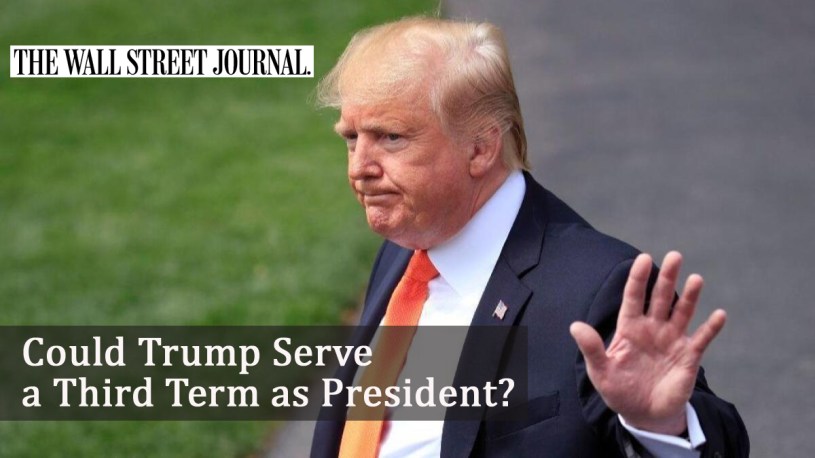
The Constitution forbids his election again, but another path isn’t entirely foreclosed.
[Excerpts of article published on The Wall Street Journal website on 31 March 2025 under the heading “Could Trump Serve a Third Term as President?”]
[By Jacob Gershman]
President Trump says he isn’t joking about considering a third term in office. The Constitution forbids him from running again, but the notion that he could legally extend his presidency isn’t entirely laughable either, according to some legal scholars. Here’s what to know about the prospects of Trump returning to office after his term expires.
What does the Constitution say?
The 22nd Amendment, ratified in 1951, states, “No person shall be elected to the office of the President more than twice.”
Republican lawmakers drafted the amendment in 1947 after recapturing Congress the year before. They wanted to prevent another president from entrenching power in the manner of Franklin D. Roosevelt, a Democrat who was elected an unprecedented four times and died in office in 1945 after more than 12 years in the White House. No president before FDR had ever served more than eight years. His successor, President Harry Truman, thought term limits were driven by “Roosevelt haters,” but enough Democrats provided support to send the amendment to the states for ratification.
Given that clear language, what possible strategy could Trump have?
There is no debate that the 22nd Amendment renders Trump ineligible for election to a third term. And any proposed repeal initiated by Congress would need to pass both houses by a two-thirds vote and then be ratified by three-fourths of the state legislatures. Republicans don’t have anywhere near that supermajority control of Congress and statehouses.
An election victory, however, isn’t the only path to the presidency. And the question of whether a president can serve in office for more than eight years is more complicated than whether he can be elected more than twice.
One way it could work, Trump said, would be a ticket swap with his vice president. In that scenario, JD Vance would run for president in 2028, and Trump would be his running-mate. If elected, Vance could then step down and hand the reins back to Trump.
What do constitutional experts say?
Some scholars say there is no such thing as a vice-presidential loophole. They point to the 12th Amendment, which states “no person constitutionally ineligible to the office of President shall be eligible to that of Vice President of the United States.” …
“Since you’re not electable as president, you’re not eligible to be president, and therefore you’re not eligible to be vice president,” said Yale University constitutional law professor Akhil Reed Amar.
Still, there isn’t total consensus on the question.
A 1999 Minnesota Law Review article called “The Twice and Future President” dug deeply into the history of presidential term limits and concluded that the text of the 12th Amendment was ambiguous enough to potentially leave the door open to a vice-presidential run by a term-limited president.
Bruce Peabody, a professor of government and politics at Fairleigh Dickinson University and lead author of that article, said it isn’t obvious that Trump is limited to eight years of service. “The weight of historical evidence, legal analysis and the constitutional text add up to make this the most defensible reading,” he said.
“There is a possible loophole. I wish it weren’t true, but there is.”
Amar said it is possible Trump could attempt to extend his presidency another way. If another Republican is elected president next time, that person could appoint Trump secretary of state, he said. It is possible Trump could then return to the White House if the president and vice president resigned, Amar said. He added that it is possible Trump could assume the presidency if all others ahead of the secretary of state in the line of succession step aside.
Federal law establishing the presidential line of succession excludes cabinet officials who are ineligible to be president, but Congress could loosen that restriction through normal legislation without amending the Constitution.
“There is a possible loophole. I wish it weren’t true, but there is,” Amar said.
 Presidential System