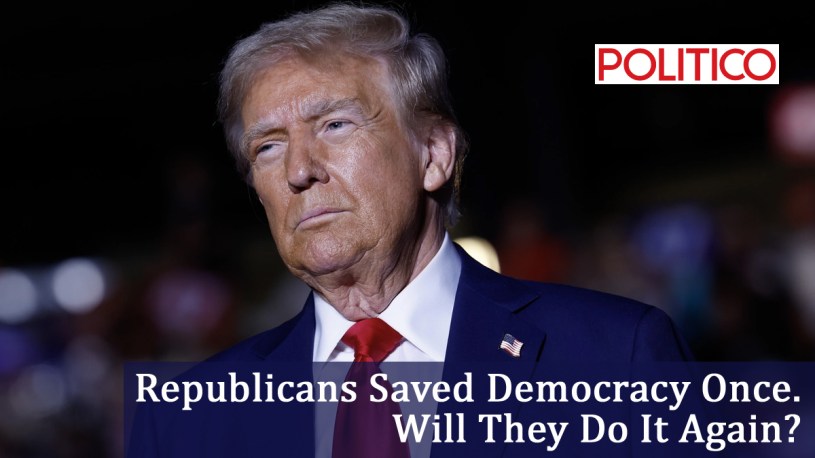
The danger to democracy is particularly acute in political systems led by parties where leaders wield disproportionate influence…
[Excerpts of article published on the Politico website on 12 January 2025 under the heading “Republicans Saved Democracy Once. Will They Do It Again?”]
[By Andrea Kendall-Taylor, Joseph Wright and Erica Frantz]
We’ve studied democratic erosion in countries around the world, and our research has found that the most important bulwark against an elected leader undermining democracy doesn’t come from opposition parties or pro-democracy activists. It comes from the ruling party — and particularly the powerful elites in that party — and their efforts to constrain their own leader.
The danger to democracy is particularly acute in political systems led by parties where leaders wield disproportionate influence relative to the political parties that back them — as is now the case in the Republican Party. Our data on all democratically elected leaders around the globe in the 30 years since the end of the Cold War show that where leaders dominate the parties they lead, the chances of democratic backsliding increase, whether it’s through gradual democratic decay or a rapid collapse.
In the United States, we tend to assume that constitutional checks and balances, including the powers vested in Congress or the Supreme Court, play the central role in constraining a rogue executive and any power grab they might attempt. But we’ve found that institutions can do so only if the members of the president’s party inside those institutions are willing to use their authority in the face of executive abuses or overreach.
The reason that often doesn’t happen is because when a political party becomes dominated by the leader as an individual, party figures view their political fates as directly tied to that of the leader, not to the long-term reputation of the party, and so they are unwilling to push back against the leader’s actions. In these “personalist” political parties, the party elite are even willing to go along with a leader’s abuse of power if they see that doing so is advantageous for keeping their jobs.
From Hungary to El Salvador and Turkey to Tunisia… the playbook these personalist leaders use to dismantle democracy has been identical. Once elected, personalist leaders promote unqualified loyalists and family members to positions of power.
The impact affects more than just the political class. When prominent party figures tolerate — or indeed even support — a leader’s anti-democratic actions, it fosters public acceptance of those actions among party supporters, as people take important cues from their elected officials. High levels of polarization and the resulting disdain for the other side only make matters worse, as partisans are willing to accept abuses of power if it means keeping the other side out of office. Indeed, even when there remains a high level of public support for democracy, our research shows that societies can slide down a non-democratic path simply because they don’t want the other side to win.
Such has been the fate of a rising number of democracies around the globe, ranging from Hungary to El Salvador and Turkey to Tunisia. Despite different political and historical contexts, the playbook these personalist leaders use to dismantle democracy has been identical. Once elected, personalist leaders promote unqualified loyalists and family members to positions of power. They fabricate threats, demonize political opponents and harass critical voices in the media. They attack the legitimacy of the judicial system while presenting themselves as above the law, attempt to circumvent any legislative constraints and fire government officials who question their behaviors or actions.
These actions occur because elites in the incumbent political party do not push back — indeed, contradicting a personalist leader risks career suicide for high-ranking party officials. That’s the way the party becomes synonymous with the leader and — especially when these parties win a legislative majority — their presidents and prime ministers can behave as they choose.
During Trump’s first term, key Republicans didn’t let that happen. In July 2020, Trump floated the idea of postponing the November election but numerous Republicans — including Senate Majority Leader Mitch McConnell and House of Representatives Minority Leader Kevin McCarthy — dismissed the idea. Later that year, elected Republicans, including a secretary of state in Georgia, a governor in Arizona and electors in Michigan, refused to falsify vote counts to keep Trump in power. Trump’s handpicked acting attorney general turned down entreaties to conjure up fake evidence of voting irregularities. And Republican-appointed judges in courts in Pennsylvania, Wisconsin and the U.S. Supreme Court upheld the law in the face of Trump’s attempts to cling to power. Perhaps the most crucial move to save democracy was when Vice President Mike Pence rejected Trump’s pleas to overturn the election when certifying the Electoral College count.
But while some Republican leaders stood up for democracy in Trump’s first term, many party leaders are likely to find it more difficult to oppose the incoming president this time because over the last four years, Trump has tightened his control over the GOP, making it more like the personalist parties that support autocrats elsewhere. …
Andrea Kendall-Taylor, Joseph Wright , and Erica Frantz are the authors of The Origins of Elected Strongmen (Oxford University Press, 2024).
 Presidential System