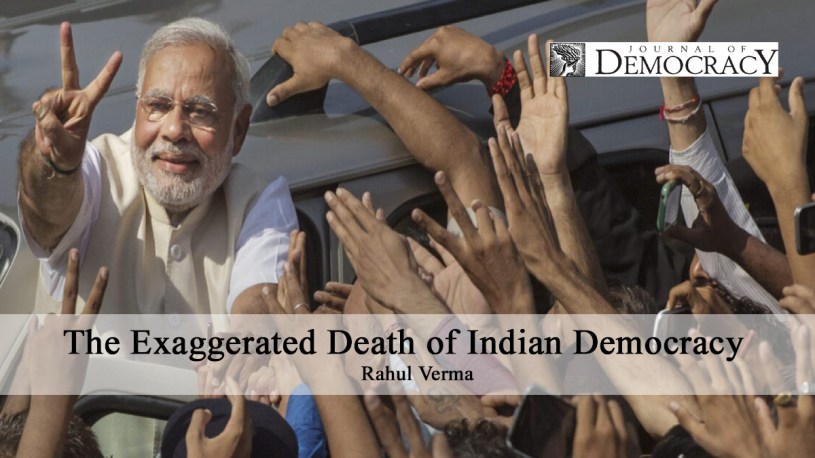
This essay recently published in the Journal of Democracy argues that India’s democracy is strained but not backsliding. The Journal simultaneously published another article entitled “Why India’s Democracy is Dying” which presents the counter view. Excerpts from both articles are posted on this website.
[Excerpts of article published on the Journal of Democracy website on July 2023]
[By Rahul Verma]
Prime Minister Narendra Modi’s government, led by his Bharatiya Janata Party (BJP), is now in the final year of its second term, and underlying every global assessment of its performance is India’s perceived democratic backsliding. Since this term began in 2019, major democracy watchdogs have downgraded India’s status to a “flawed democracy” and an “electoral autocracy.” These ratings are not without debate—after all, they rely on an array of subjective variables, not to mention country experts with their own ideological preferences. There is, however, a near consensus among scholars that the country’s political culture is undergoing a momentous transition, and now can at best be described as an “electoral democracy,” as liberal elements of its democracy are under siege. Democracy watchers and scholars alike point to a serious deterioration in civil liberties, intolerance of religious minorities, and the weakening of institutional autonomy as the primary sources of democratic decline in India. Not surprisingly, they also highlight the actions and inactions of Modi’s government as the key drivers behind India’s democratic backsliding.
I would argue, however, that claims of Indian democracy’s death are highly exaggerated. Systemic features of a dominant-party system that is also marked by deep partisan polarization are being conflated with democratic backsliding. This is not to suggest that there are no reasons for concern—institutions are under stress and treatment of religious minorities (especially Muslims) in many parts of India have worsened. Yet a recency bias seems to be coloring our evaluations of the health of Indian democracy. Its problems did not begin with the rise of the BJP under Modi, nor are the party and prime minister solely responsible for the current morass. It has been long in the making.
…
The Debate on India’s Democratic Health
There is an emerging consensus that the foundational principles underpinning India’s “first republic” are making way for a “new India” with a completely different political culture—one that is antithetical to the country’s constitutional vision. This purported assault on democracy includes the fusion of the ruling party and the state. Some scholars have described Modi’s ascendence as a “counterrevolution” of the upper castes, who rallied behind the BJP to push back against the increasing assertion of lower castes (in terms of rights and inclusion), which has defined Indian politics for the past few decades. Others have alluded to the more centralizing tendencies of this regime, in which the previously settled federal compact with states is under strain, crony capitalism is taking deeper root, and the nature of India’s welfare state is changing.
Proponents of this view argue that the BJP government is ignoring India’s democratic norms and destroying its democratic institutions. In their opinion, the government has severely limited freedom of expression and has used police and security forces to quash dissent. At the same time, the government has done nothing to prevent (and has even been complicit in) anti-Muslim vigilantism, which is becoming increasingly normalized. Judicial independence is questionable, as recent court rulings have sided with the government on civil liberties and dissent, in clear contradiction to the constitution. The independence of the Election Commission is likewise now in doubt given recent biased rulings in favor of the BJP.
Others, however, see the emergence of a new political consensus as symbolic of “economic transformation, democratic deepening, social assertion, rejuvenation of the Indian nation and renaissance of the Indian civilization.” This point of view hails the current moment as liberation from the “myth of secular-socialist India” and a much-needed correction of India’s original break from the “civilizational” past.
…
Constitutions are rarely perfect, nor are the exercises of their making. Similarly, the assertion that the erosion of democratic values is the creation of one party and its recent electoral success is an untenable oversimplification. Along with the recency bias, we have also seen that parties in power at the state level generally do not receive the same degree of criticism as the BJP for violations of democratic norms—for example, election violence in West Bengal (ruled by the Trinamool Congress party since 2011, and the Communist Party of India (Marxist) before that).
To be fair, many scholars have explicitly acknowledged that the BJP is not alone in instrumentalizing the state machinery for political purposes. Not only did the previous Congress national governments use the state machinery to settle scores with political opponents, but so did many state governments in the past four decades. It was under Prime Minister Indira Gandhi (1966–77), after all, that the idea of a “committed judiciary and bureaucracy”—that is, loyal to the government— was put into practice. Successive governments at both the national and state levels have followed this principal. The record of Congress-led national governments using Article 356 of the constitution to suspend opposition-led state governments is well documented, as is the longtime decline in parliament’s productivity as a forum for democratic deliberation.
Finally, the economic and political marginalization of India’s religious minorities, especially Muslims, is well documented. The problem of declining Muslim representation in politics is not simply the product of the BJP’s rise; it has always been low. Relations between India’s Hindu and Muslim communities were never addressed through a national dialogue after the partition (1947) and have evolved without any formal effort to determine the place of Muslims in India’s body politic. After all, religious tensions between Hindus and Muslims have been described as one of the metanarratives of post independence Indian politics. None of this is meant to whitewash the failures of the present regime, but simply to put a comparative lens on India’s democratic health.
…
How do Indian citizens view their country’s democracy? Many surveys conducted in the past few years have found that a majority of respondents are satisfied with the state of Indian democracy. More than 60 percent of Indians surveyed for Pew Research Center’s 2020 report on democratic values and satisfaction said they were satisfied with how democracy was working in the country.
…
Indians may be satisfied overall with the country’s democratic status, but that does not mean that they are unconcerned about where India’s democracy is headed or that they do not worry about the safety and well-being of marginalized people—religious minorities, the poor, women, and the lower castes. The CPR-CVoter survey asked respondents if they believed that India could slide into autocratic rule. About 39 percent seemed to think this was a real possibility, a 51 percent majority did not, and 10 percent were uncertain. There are clear partisan differences on these questions, with opposition voters more likely to believe that India’s democratic norms are under duress. There is also a noticeable partisan divide, though not as sharp, in how trustworthy respondents perceive institutions to be. …
A New Reality
India has always been unique among the world’s democracies, which means that it cannot be properly understood using the same measures and standards that are used to assess Western democracies. It is true that the emerging politics under BJP rule is a break from the past, but to reduce the current moment, which is marked by several contradictory tendencies, to democratic backsliding would be an injustice to India’s journey as a democracy. …
[Rahul Verma is a fellow at the Centre for Policy Research in New Delhi.]
 Presidential System