[By Bhanu Dhamija]
[A version of this article was published on The Quint website on 19 March 2025.]
India’s unity faces a new challenge. Smaller states, particularly in the South, are banding together to oppose the government’s planned Delimitation—a constitutionally required process to redraw parliamentary constituencies based on population.
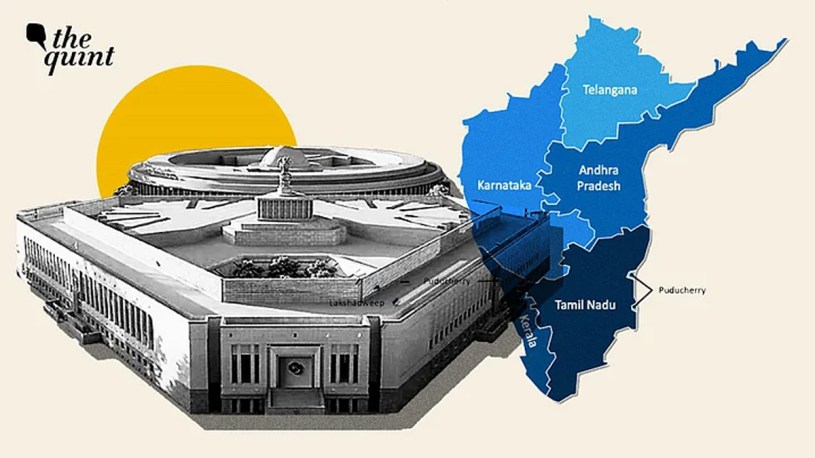
Tamil Nadu, Kerala, Karnataka, Telangana and other small states fear that the upcoming census will result in them losing parliamentary seats to larger northern states like Uttar Pradesh and Bihar. They argue that they are being penalized for successfully controlling their population growth. Tamil Nadu Chief Minister M.K. Stalin has called Delimitation “a threat aimed at reducing our representation and silencing our voice.”[1]
However, Delimitation presents an opportunity for small states—if they truly unite—to gain more representation and a stronger voice. By coming together, they can help reform Parliament, where many groups are underrepresented, and improve Federalism, where all states are hindered by an overly dominant Centre.
Our Parliament does not represent this large, diverse nation adequately, making it ill-suited for meaningful national discussions. Compared to other democracies, it significantly under-represents the population. On average, an Indian MP represents 2.4 million citizens, while in the U.S. the number is 748,000, in Pakistan it’s 576,000, and in Japan only 273,000. Political scientists Milan Vaishnav and Jamie Hintson estimated that, based on the 2011 census, the Lok Sabha should have 848 MPs, up from the current 545.[2] Under this truly representative model, Uttar Pradesh would have 143 seats, while Kerala would have just 20. However, due to concerns from smaller states, the number of Lok Sabha seats has not been revised since 1973.
The answer lies in reforming the Rajya Sabha, transforming it into a chamber where all states have equal representation, similar to the American Senate.
If smaller states embrace Delimitation and allow for an increase in the number of Lok Sabha seats, Parliament would better reflect the sentiments of the people. But how can smaller states gain more influence in India’s governance?
The answer lies in reforming the Rajya Sabha, transforming it into a chamber where all states have equal representation, similar to the American Senate. Smaller states can push for this reform by uniting and advocating for a constitutional amendment. After all, the Rajya Sabha (Council of States) was designed to be the voice of the states and to prevent hasty, ill-conceived legislation. Unfortunately, it currently fails to fulfill either role.
Today, the Rajya Sabha mainly represents political party leaders and serves as a tool for partisan politics. This is especially true since the 2003 constitutional amendment that removed the requirement for Rajya Sabha members to be elected from the state they represent. In 2016, Kuldip Nayar, a Rajya Sabha member and political commentator, noted, “Now the whole house is nominated by political masters.”[3]
Transforming the Rajya Sabha would not only make our Parliament more effective but also go a long way in strengthening India’s federalism. The “cooperative federalism” that India touts exists more in name than in practice. States are expected to comply with the Centre’s demands or face consequences. Uncooperative state governments are penalized by having their laws blocked, being excluded from new programs or institutions, having their legitimate funds withheld, or, in the worst case, being placed under President’s Rule. According to the Sarkaria Commission’s study of 57 instances of President’s Rule in the 1980s, nearly 50% were due to the central government’s actions. Today, many laws passed by opposition-led state governments are still stalled by the Centre. For example, Tamil Nadu has around 20 bills pending, West Bengal has 22, and Kerala has 7. As Granville Austin, the chronicler of India’s Constitution, noted, “the state rabbits… never combined against the central wolf.”[4]
India has already successfully implemented the principle of equal representation for state governments in addressing significant national issues. The GST Council, for instance, includes one representative from each state and union territory—the state Finance Minister.
In the United States, equal representation of state governments in one chamber of their parliament (Congress)was the unifying idea that saved them from falling apart in 1787. This Great Compromise (also known as “Connecticut Compromise”)was an agreement reached between large and small states during the drafting of their Constitution. Larger states wanted representation based on population, which would give them more power in the legislature, while smaller states feared being overshadowed and losing influence. The American Founders sought a middle ground that would protect the interests of both sides and prevent any group from dominating the legislative process. As William Samuel Johnson, a key proponent from the small state of Connecticut, stated, “Instead of being opposed to each other, [the states] ought to be combined: that in one branch the people ought to be represented, in the other, the states.”[5]
India’s leaders—across all parties and from large and small states—should show similar wisdom. Delaying Delimitation yet again, as has been done for the past 50 years, is not a wise choice. It is harming India’s unity and weakening its democracy.
[1]https://www.reuters.com/world/india/indias-north-south-divide-over-modis-plan-redraw-constituencies-2025-03-04/
[2]https://www.hindustantimes.com/elections/lok-sabha-election-2019/lok-sabha-elections-2024-a-new-challenge-for-federalism-101608344738316.html
[3]https://presidentialsystem.org/2016/03/12/presidentialsystemrajya/
[4]https://presidentialsystem.org/2016/06/05/indians-want-and-deserve-a-true-federation-not-a-pseudo-one/
[5] Why India Needs the Presidential System by Bhanu Dhamija, HarperCollins 2015, p.233
 Presidential System