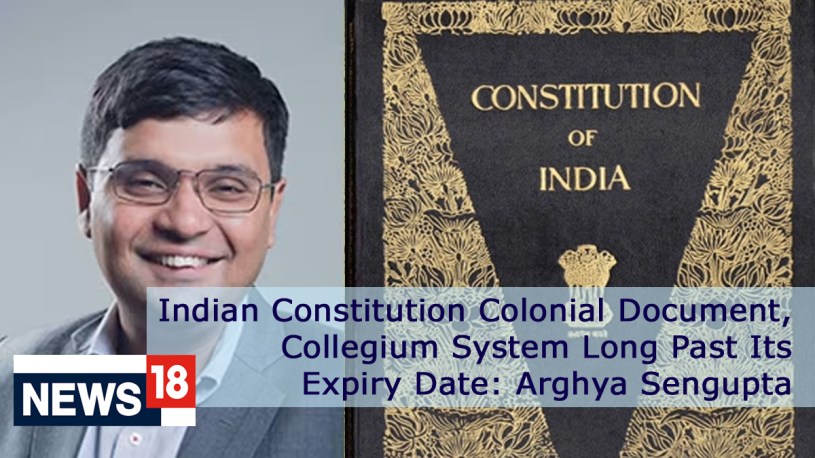
[Excerpts of article published on News18 website on 11 October 2023.]
Indian Constitution Colonial Document, Collegium System Long Past Its Expiry Date
Arghya Sengupta questioned if the UK can do away with the collegium system more than 700 years of tradition, what is 70 years of tradition in India
The Constitution is a colonial document where the state is all-powerful and India, which has an experience of 75 years of independence, has the confidence to decide what kind of constitution works best for the country, Arghya Sengupta, founder of Delhi-based think tank Vidhi said in an interview.
Sengupta, a prominent voice on constitutional issues who has recently written “The Colonial Constitution”, also said that the collegium system for selecting judges is long past its expiry date. He also touched upon several other constitutional aspects including basic structure doctrine, fundamental duties and preventive detentions.
Here are edited excerpts from the interview:
The constitution is a colonial document where the state is all-powerful and pervading and towers over the people of India.
Q: ‘Decoloniality’ has become a buzzword and decolonisation is seemingly a larger cultural and political project that aims at getting rid of all colonial vestiges. Do you foresee some major changes that will take place in the constitution as well?
I can’t foresee whether any changes will take place or not, but I think that we should debate and discuss what changes should take place. There are two reasons, which I have also mentioned in my book. First, the constitution is a colonial document where the state is all-powerful and pervading and towers over the people of India. For India to grow and prosper in the 21st century, we have to ensure that the people are trusted and empowered in order to make sure that they can bolster not only their own destiny but also their national destiny. This will not happen through control, but trust.
The second reason is that the entire edifice of the Constitution is based on broadly an Anglo-American governance model. I have used the words “entire edifice” advisedly to show that I am not talking about individual articles taken from here and there, but the framework itself. Now, this is not to belittle the framers because the framers felt at that time that that was what was best for India.
Now, with the benefit of 75 years of independence, we have the confidence and the experience to be able to think for ourselves about what kind of constitution will work best for India. To give a simple example, think about why is it that litigation through courts is the primary form of dispute resolution in India, as the constitution envisages. Why should it not be mediation, an idea that has old roots and is very much ingrained in our ethos? So, these are the things that we need to rethink. Whether these changes will happen, I don’t know. But some changes should take place.
Q: You call the Indian constitution a ‘Colonial’ one, yet you don’t argue in any manner to junk it. What, according to you, are the three features which could be junked to make Constitution less colonial?
There are two things that I think are critical. First, the idea of fundamental duties needs to be completely rethought. Inadequate attention has been paid to duties in the constitutional framework and the cause of fundamental duties has been further set back by the fact that the kind of fundamental duties introduced by the 42nd amendment don’t make us a stronger civic democracy. The amendment is not talking about ways in which we can become better citizens of the country.
Second, the idea of preventive detention needs to go. Now, India cannot grow by simply becoming a strong law and order state. This does not mean at all that our law and order should be weak. But citizens have to be trusted. Preventive detention was brought in at the time of partition. We felt that there were severe law and order issues at that point in time. We are fortunate that we don’t have law and order issues as severe as that, today. But the Constitution continues to sanction preventive detention and I think this is important considering the sheer number of people who are detained in this country under different laws, which were more than 86.6 lakh in 2021. This is a huge number. If it was changed, it will have a symbolic value to show that the state trusts its people.
The biggest problem with the basic structure doctrine, as was clearly seen in the National Judicial Appointments Commission case, was that it is prone to significant misuse.
Q: Basic structure doctrine was not part of the original Constitution. It was a judicial invention. In the recent past, we have seen that there has been a tussle on this issue between the judiciary and the executive. Do you think that basic structure doctrine gives unfettered power to the judiciary or it is okay to have the basic structure doctrine?
Basic structure doctrine is a classic example where the ends justify the means. It was brought up in a particular context when Indira Gandhi was the Prime Minister and she was showing disregard to the constitutional framework and what the Supreme Court judges decided. So, it was brought in that context and it was widely supported at that point in time because it averted a constitutional crisis where essentially the elected executive government and parliament could steamroll the Supreme Court and the judiciary.
I could be supportive of the basic structure, provided I know what it is. The biggest problem with the basic structure doctrine, as was clearly seen in the National Judicial Appointments Commission case, was that it is prone to significant misuse. So, I can understand when we say democracy and the rule of law are part of the basic structure of the Constitution, but I cannot understand when we say judicial primacy in the appointment of judges is part of the basic structure of the Constitution.
If the basic structure is going to be reduced to what the judges say it is, as has been the case in this NJAC judgment, then I think the basic structure doctrine should be revisited. …
Q: Do you think that the new system of appointment of the judges is needed or Collegium system is functioning well?
…The fact of the matter is that the collegium system is long past its expiry date and I am very clear that the collegium system should go. I was feeling gratified that Mr Nariman wrote that article because it shows two key things. First, just because you have changed the dynamic between the executive and the judiciary in appointment doesn’t mean that you will get better judges or a process that is more transparent. Reform of judicial appointments has much more to do with the process than who is appointing. So, we must ensure that there are objective criteria, transparency, and certain recorded reasons. We must ensure, if possible, that there is an interview process. We have got this system from the United Kingdom.
But now, in the United Kingdom, Court of Appeals judges apply to become Supreme Court judges and they are interviewed. If the UK can do away with more than 700 years of tradition, what is 70 years of tradition in India? We need to think more seriously about transparency in the process. …
 Presidential System